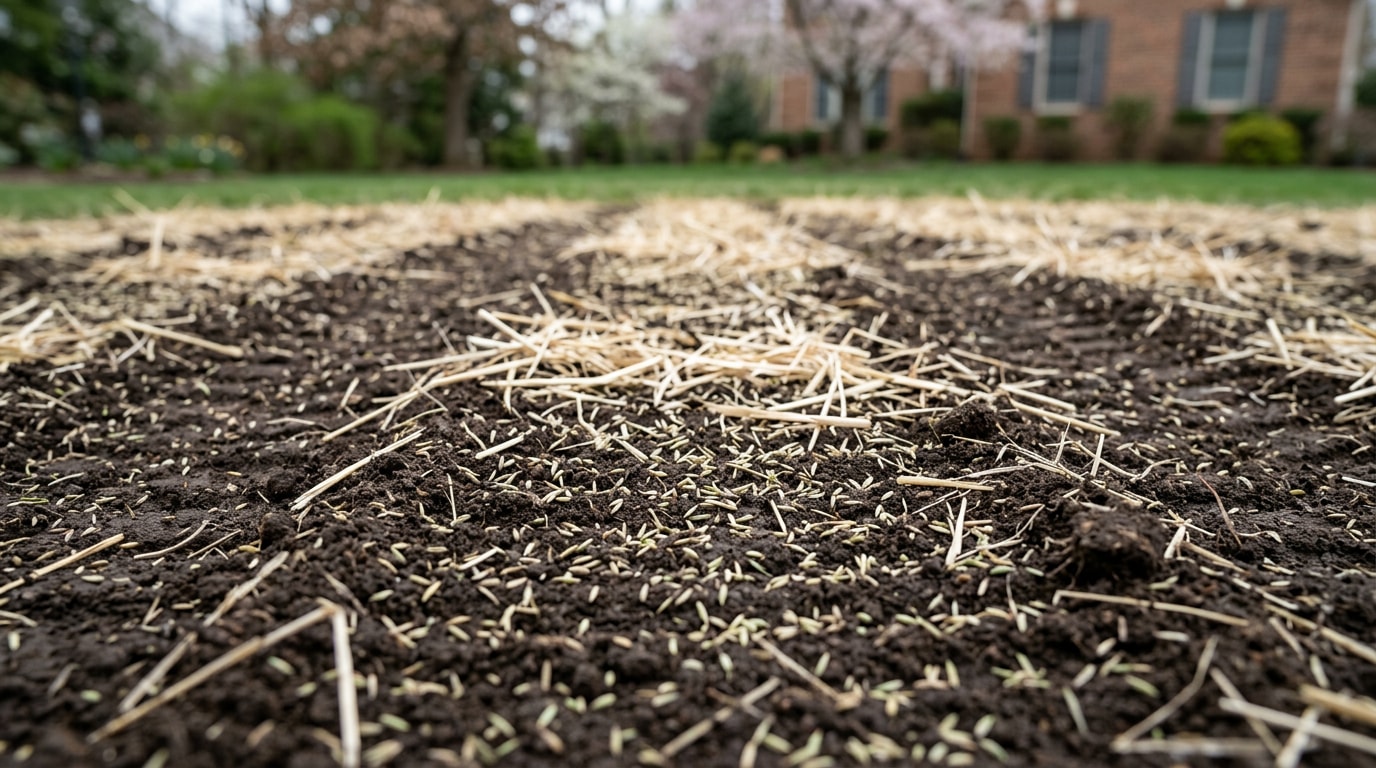
A grass seed calculator for Fairfax, VA turns your lawn's square footage into the exact pounds of seed to buy, instead of guessing at the garden center. Fairfax sits in the transition zone, where cool-season seeding rates run differently than the flat national averages most generic calculators use. Below is the math, the Virginia-specific rates, and the adjustments that can swing your total by 30% or more.
How to Calculate How Much Grass Seed You Need
The seeding rate formula never changes: divide your lawn's square footage by 1,000, then multiply by the recommended rate per 1,000 sq ft for your grass type and project.
Most homeowners get stuck on two follow-up questions. How does that number translate per square foot? And how does it scale up to acreage pricing for a larger property? The sections below answer both.
How Much Grass Seed Per Square Foot?
A seeding rate of 6 lbs per 1,000 sq ft works out to 0.006 lbs of seed per square foot. For a 2,000 sq ft yard, that's 12 lbs total. The rate scales linearly, so doubling your lawn size simply doubles the seed needed.
How Much Grass Seed Per Acre?
One acre equals 43,560 sq ft, so multiply your per-1,000-sq-ft rate by 43.56 to get pounds per acre. At a 7 lb/1,000 sq ft midpoint rate, tall fescue lands around 305 lbs per acre. Kentucky bluegrass at 2.5 lbs/1,000 sq ft runs closer to 109 lbs per acre.
Seeding Rates by Grass Type for Fairfax Lawns
Fairfax County sits in the transition zone, where cool-season grasses dominate and seeding rates differ from a generic national average. This is also where most calculators oversimplify. Virginia Cooperative Extension lists seeding rates of 2-3 lbs per 1,000 sq ft for Kentucky bluegrass, and 6-8 lbs per 1,000 sq ft for straight tall fescue, fine-leaf fescue, or perennial ryegrass.
Here's the nuance most national tools miss: that 6-8 lb range applies to straight species, not the tall fescue blends sold at most Northern Virginia garden centers. Virginia Cooperative Extension guidance for lawn establishment puts tall fescue blends at 4 to 6 pounds per 1,000 square feet, and standard mixtures of 90-95% tall fescue with 5-10% Kentucky bluegrass at 3 to 4 pounds per 1,000 square feet. If your bag is labeled as a blend rather than straight tall fescue, your actual total will run lower than a generic calculator suggests, sometimes by close to half.
Quick reference by species and project type:
- Tall fescue (straight species): 6-8 lbs/1,000 sq ft new, 3-4 lbs/1,000 sq ft overseed
- Tall fescue blend (90-99% TF): 4-6 lbs/1,000 sq ft new
- Standard tall fescue/Kentucky bluegrass mixture: 3-4 lbs/1,000 sq ft new
- Kentucky bluegrass: 2-3 lbs/1,000 sq ft new, 1-1.5 lbs/1,000 sq ft overseed
- Perennial ryegrass: 6-8 lbs/1,000 sq ft new, 3-4 lbs/1,000 sq ft overseed
- Fine fescue blends: roughly 3-5 lbs/1,000 sq ft new, lighter to overseed
New-lawn rates run higher than overseed rates because bare soil needs full-density coverage. Existing turf only needs enough seed to fill thin spots, since the established grass is already carrying most of the density.
Grass Seed Needed by Lawn Size: Worked Examples
Use this table as a sanity check against whatever number a calculator spits out. Rates are midpoints of the ranges above: tall fescue new at 7 lbs/1,000 sq ft, tall fescue overseed at 3.5 lbs/1,000 sq ft, Kentucky bluegrass new at 2.5 lbs/1,000 sq ft, and perennial ryegrass new at 7 lbs/1,000 sq ft.
| Lawn Size | Tall Fescue (New) | Tall Fescue (Overseed) | Kentucky Bluegrass (New) | Perennial Ryegrass (New) |
|---|---|---|---|---|
| 1,000 sq ft | 7 lbs | 3.5 lbs | 2.5 lbs | 7 lbs |
| 2,500 sq ft | 17.5 lbs | 8.75 lbs | 6.25 lbs | 17.5 lbs |
| 5,000 sq ft | 35 lbs | 17.5 lbs | 12.5 lbs | 35 lbs |
| 10,000 sq ft | 70 lbs | 35 lbs | 25 lbs | 70 lbs |
| 1 acre | 305 lbs | 152 lbs | 109 lbs | 305 lbs |
If you're seeding a tall fescue blend instead of straight fescue, use the 4-6 lb Virginia Cooperative Extension blend rate noted above instead of this table's 7 lb straight-species midpoint. Your actual bag total will land lower.
How Much Does a Bag of Grass Seed Cover (and Cost)?
Bag coverage depends on bag weight and species rate together, not just bag weight alone. A 50 lb bag of tall fescue at the new-lawn midpoint (7 lbs/1,000 sq ft) covers roughly 7,100 sq ft. The same 50 lb bag in Kentucky bluegrass, at 2.5 lbs/1,000 sq ft, stretches closer to 20,000 sq ft. Smaller 25 lb bags cover half that area.
Quality tall fescue blends typically run $60 to $120 per 50 lb bag at Fairfax-area garden centers, with coated or shade-tolerant formulas priced higher. If you're weighing seed cost against the cost of a full yard renovation, including grading, drainage, or hardscape work like a new patio tied into the lawn plan, it's worth pricing both pieces together before you buy a single bag.
What Changes How Much Grass Seed You Actually Need
The formula above assumes perfect conditions, and real lawns rarely cooperate. A few factors shift your real-world total:
- Germination percentage.
The seed tag lists individual cultivars by percentage of weight in the bag, along with their germination percentage. A bag rated 70% germination needs a higher application rate than one rated 90% to deliver the same final stand.
- Pure live seed (PLS).
PLS is calculated by multiplying the percentage of pure seed by the percent germination, then dividing by 100. Serious growers calculate against PLS rather than raw bag weight, since PLS accounts for both purity and viability.
- Seed coating. Coated seed adds a thin nutrient or polymer layer, which can make a posted rate read differently than it would for raw seed. Check whether a rate chart assumes coated or raw seed before trusting it.
- Seeding depth.
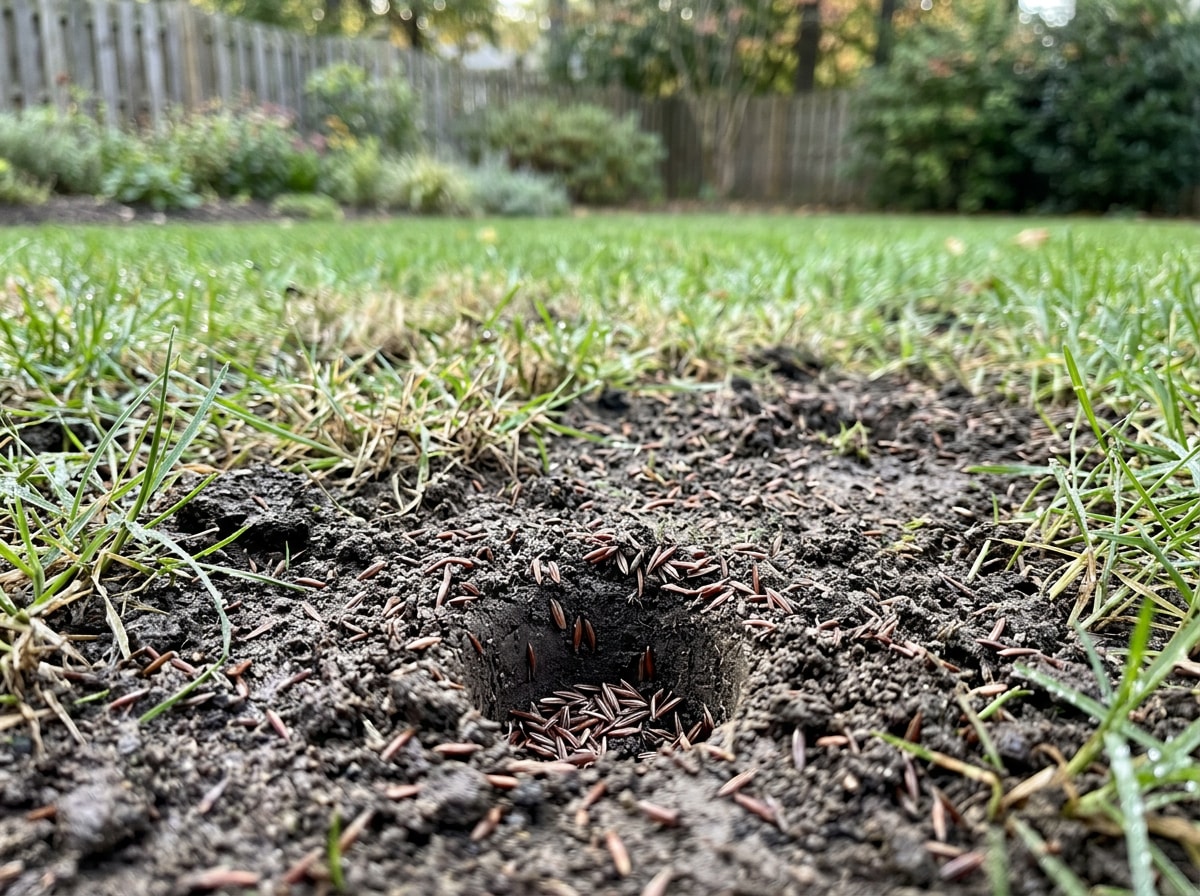
Small-seeded grasses like Kentucky bluegrass need to stay right at the soil surface, while larger-seeded grasses like fescues and ryegrasses can be planted as deep as half an inch.
- Site conditions. Compacted soil, heavy shade, or steep slopes all justify bumping your rate toward the higher end of the range.
- Seed labeling.
Virginia law requires every agricultural seed label to state the percentage of germination, exclusive of hard or dormant seed. Always check this figure against the rate you're calculating from.
Best Time to Seed Grass in Fairfax, VA
For Northern Virginia and lower-elevation parts of Western Virginia, the best seeding dates run mid-to-late March for spring seeding, and the last week of August through mid-September for fall seeding. Fall is the stronger window for Fairfax lawns: cooler air, warmer soil, and less weed competition all favor fall-seeded tall fescue over spring plantings.
When our crews prep Fairfax and Fairfax County yards for new tall fescue, clay subsoil just under the topsoil is the norm, not the exception. We default to the upper half of the seeding rate range on compacted sites and always recommend core aeration first, since poor seed-to-soil contact costs homeowners more lost seed than any rate miscalculation we see in the field.
If overseeding an existing lawn is your goal rather than a full renovation, our guide on overseeding an existing lawn walks through the prep steps in more detail.
Planning work that goes beyond the lawn, like regrading, a new walkway, or a retaining wall before you seed? Contact CM Hardscapes for a free estimate, and we'll help you sequence the hardscape and lawn work so neither one gets torn up by the other.
FAQ
How Much Grass Seed Do I Need Per 1,000 Square Feet?
It depends on species and project type. Straight tall fescue runs 6-8 lbs/1,000 sq ft for a new lawn, tall fescue blends run 4-6 lbs, and Kentucky bluegrass runs 2-3 lbs. See the seeding rates section above for the full breakdown.
How Much Grass Seed Do I Need for Overseeding?
Because existing turf is already carrying density, overseeding rates run lower than new-lawn rates, with tall fescue or tall fescue mixes typically overseeded at 3-4 lbs per 1,000 sq ft. Thin lawns with decent existing turf can use the lower end; patchy or heavily bare lawns should lean higher.
How Much Does a 50 lb Bag of Grass Seed Cover?
A 50 lb bag of tall fescue covers roughly 6,000 to 7,100 sq ft at new-lawn rates. The same bag in a lighter-rate grass like Kentucky bluegrass can cover up to 20,000 sq ft.
What Does Germination Percentage Mean on Grass Seed?
Germination percentage is the share of seeds in a bag expected to sprout under proper conditions. A 70% germination bag needs a noticeably higher seeding rate than a 90% bag to reach the same final grass density.
When Is the Best Time to Seed a Lawn in Fairfax, VA?
Late August through mid-September is the top window for fall seeding in Fairfax and the rest of Northern Virginia. Spring seeding from mid-to-late March is the second-best option, though it carries more weed competition and heat stress risk.
How Much Grass Seed Do I Need Per Acre?
Multiply your per-1,000-sq-ft rate by 43.56. Tall fescue at a 7 lb/1,000 sq ft midpoint needs about 305 lbs per acre; Kentucky bluegrass at 2.5 lbs/1,000 sq ft needs about 109 lbs per acre.
Reviewed by the project estimating team at CM Hardscapes, who size seed, sod, and soil quantities for lawn and hardscape projects across Fairfax, VA) and Fairfax County. Questions about your yard plan? Get a free estimate.
Sources: Virginia Cooperative Extension, "Chapter 11: Lawns," https://pressbooks.lib.vt.edu/emgtraining/chapter/11/; Virginia Cooperative Extension, "Spring Lawn Establishment Tips," https://ext.vt.edu/lawn-garden/turfandgardentips/tips/spring_lawn_establishment_tips_2008.html; Prince William County, "Best Lawns News," https://www.pwcva.gov/assets/2021-04/2014_aug-sept_bl_news.pdf; Penn State Extension, "Lawn Establishment," https://extension.psu.edu/lawn-establishment; Code of Virginia § 3.2-4008, https://law.lis.virginia.gov/vacode/title3.2/chapter40/section3.2-4008/.